Monday, December 7, 2020

The Tandy 1000 Saga: catching up.

I'm bad at blogging.

There, just got that out of the way.

Since I last updated this blog over a year ago I've uploaded a few more YouTube videos on the subject of the memory board project I initially started a few months after getting a bare Tandy 1000 EX in the middle of 2019. A lot has happened since then. Here's the latest video, in which I'm demonstrating the capabilities of my latest and perhaps ultimate variation of a Tandy 1000 EX/HX expansion board:


Here is a link to a playlist of the previous videos.

In short, the current version of the board, which is implemented using a couple of GAL (Generic Array Logic) chips in order to fit everything (tightly) into the space available while retaining the use of through-hole parts for easy assembly, includes the following features:

  • Expands base memory of a bare 1000 EX/HX to 640K
  • A "spare" 128k is available to be mapped into the upper memory space between C0000 and EFFFF, with several switch-selectable options to optimize utilization.
  • Two additional sockets for 512k SRAMs are available and can be populated to provide 1MB of EMS memory. Page frame location is adjustable.
  • 44 pin laptop PATA connector to be used with either a CF or SD adapter to provide hard disk storage via a single-chip XT-CF-Lite implementation.
  • In-system programmable Flash ROM for the XTIDE BIOS, location is switch adjustable.
  • Dallas 1215/1315 "zero-slot" clock compatible with Radio Shack's original "Smartwatch" option.
  • Dual 9-pin 16550-compatible serial ports; switch settings allow one to use a nonstandard IRQ to free up IRQ 3 for other expansion cards while working as a dedicated mouse port in conjunction with the CuteMouse driver.
  • Expansion passthroughs compatible with the original Radio Shack cards; can be used with genuine Plus cards or with an ISA adapter for network or VGA cards.
  • With the latest GAL programming and the aid of a jumper wire can override the built-in DOS-in-ROM in the Tandy 1000 HX, freeing up memory space for use as UMB or EMS page frame. Also allows relocation of XTIDE BIOS to F0000, which is very useful if an option card that has a ROM (like a VGA card) is installed.

Anyway. This board is currently not for sale; I don't think I have the bandwidth in my life to produce it, alas. But it's been an interesting project, and very educational.


Monday, November 18, 2019

Say Hello to the Tandy 1000 SUX!

I've uploaded a new video to my Youtube Channel, it's embedded below. As usual, I don't know how to keep things brief, but at least I tried to keep it moving.

Friday, November 15, 2019

Welcome to Paleozoic PCs!

Greetings. As you've probably already guessed from the title, this little corner of Blogger is yet another Retro-computing-based blog, in this case one specifically intended as a companion for yet another retro-computing-based Youtube channel. Certainly not going to blame you for grumbling something about the market for this sort of thing being saturated and moving on, if you're so inclined. But if you haven't already done that I'll go ahead and lay out a brief introduction/sales pitch.

Collecting "retro" computers is a thing I've done since long before it was cool. Not to date myself too badly, but I am old enough to have grown up alongside the earliest 8-bit microcomputers and lived through the "Great Video Game Crash of 1983" (when suddenly my allowance went a lot further than it used to in buying Atari 2600 cartridges), so I remember when many of the home computers that are considered "retro" today were the bleeding-edge of consumer technology. Many of these machines that sold for thousands of dollars in the beginning of the 1980's were cheap garage sale fodder by the end of the decade, and I had a weakness for picking them up for practically nothing and tinkering with them, in some cases destructively. (All in the name of education and exploration, of course.) I still love doing that today, other than the destructive part, of course.

(If only they were still as cheap as they were back then...)

My attitude regarding almost any hobby is it should be a journey of discovery, not just a passive exercise in collecting. I have very little interest in owning a meticulously restored original Apple Lisa or I or whatever that sits on a pedestal and never does anything. If nothing else my house isn't big enough for that. Therefore my modus operandi is generally to only have one or two of my limited (but fairly diverse) collection out at a time, and keeping it out as long as I feel like I have some fun ideas to try out with it. Lately I've started branching out from just fiddling with/repairing the original hardware to trying to build my own hardware add-ons. So... basically, if your idea of a good time with old computers looks more like this:

Than a spotless museum case then there's a chance that you might find something I post here or on my channel interesting.

Here's a brief list of the systems I own that might find their way into the discussion:
  • "Classic" TRS-80 models 1, 4, and 4P. Also Color Computer 3
  • Tandy 1000 EX and HX (My current favorite lab rats!)
  • Several Apple II-family systems. (Frankenstein'ed II+ clone, IIc, and IIgs)
  • Some early Macintosh systems (512k, Plus, LC III)
  • Several different models of Commodore PET
  • Amiga 1000
  • Northstar S100 CP/M chassis
  • Various other bits and bobs, depending on how deep I want to dig, including UNIX workstations and some embedded development systems.
  • Whatever might happen to fall into my lap if I'm lucky tomorrow.
I can't promise how diligent I'll be updating this. I'll probably just use this space to drop some notes related to my sporadic video uploads, but maybe it'll add up to more than that. In any case, if you've read this far then thank you for your time, hope to see you again.

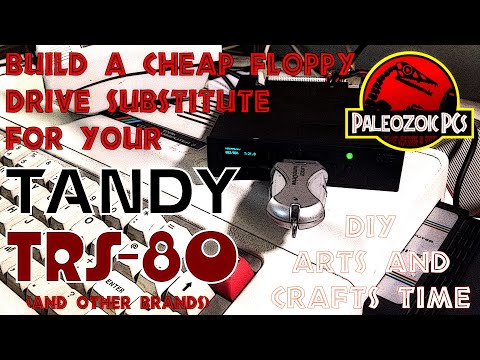
DIY-A-Fake-Floppy-Drive Video

 New video posted to Youtube, about hacking up a cheap Gotek floppy emulator into a self-contained retro floppy drive substitute for classic...